Studio

08.10.2013 BY HANNE HAGENAARS
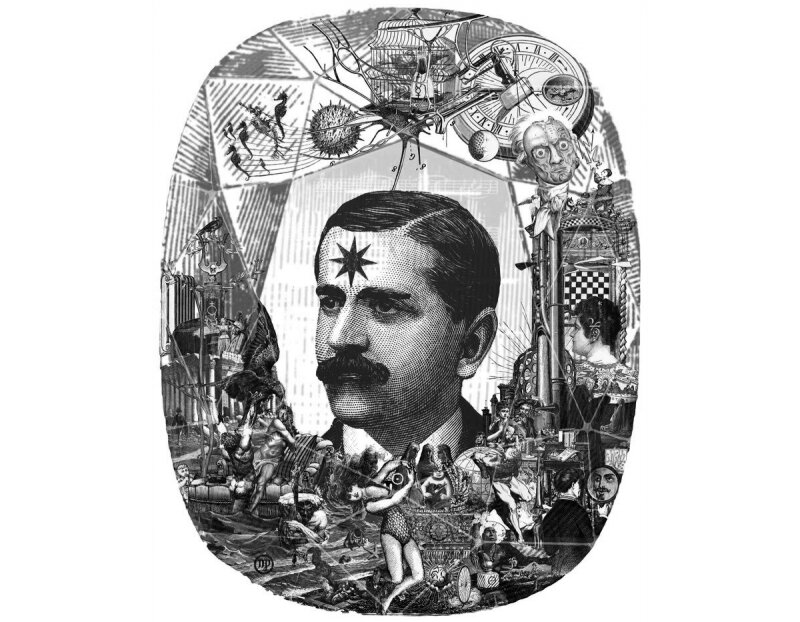
Raymond Roussel

At nineteen years of age, Raymond Roussel worked feverishly at his first grand novel, La Doublure. With great care, he shut the curtains of his study to prevent the light of his genius from escaping through the windows. Above all, Roussel refused to be distracted by the banality of the everyday world. His books were fuelled by nothing more than his endless imagination.

Many contemporary artists are just as fond of hermetically shutting their studio off from the rest of the world. There’s one artist I know who meticulously keeps the sliding doors to his studio, directly annexing his living room, firmly shut. Sometimes, when he leaves the room to fetch a book, I try to peek inside, but it’s absolutely impossible to catch even a glimpse. His scanner is in The Studio. but there’s not a chance in the world that I might make a scan myself, or even to accompany him to the other side of that door while he does it for me.

Having become slightly apprehensive at so much secrecy, I sometimes fantasize about an illegal photographer hiding in there, making all his work. Or that my friend copies all his work from old encyclopaedias or from smutty porn. That’s the great thing about art today, everything can be used as a source, which means that everything is possible.

The studio is traditionally seen as the place from which work originates while at the same time, it’s the prison in which the artist must endure hour upon hour of lonely isolation. Doubt seeps through the walls of the workplace like damp, and the artist asthmatically gasps for air. Every artist in the studio is a lonely hero.

Pollock’s studio

Replica by Joe Fig

Artist Jackson Pollock needed the loneliness of the studio to come to his unique expressive drip paintings. “I am nature” was his response to the artist’s endless attempts at replicating nature. Like a gladiator, he stands in the middle of his canvases, allowing the paint to drip from the stick in his hand. The artist and his work are one. It’s precisely this location, laden with expression and drama, which is seen in replica form in a photo by Joe Fig.

Within the miniature sculpture, the studio is recreated in minute detail (based on Hans Namuth’s photos) and shows the master in the midst of his canvases on the ground, surrounded by paint in shades exactly corresponding the photo. Each detail is correct. The sculptures demand knowledge of the perspective, of the colour, and insight of the artist. Joe Fig’s craftsmanship is praised, and so it seems that a genius is needed to make a perfect copy, However fascinating the work may be, it never quite extends past the original, nor does it exalt kitsch nor the Gepetto-syndrome.

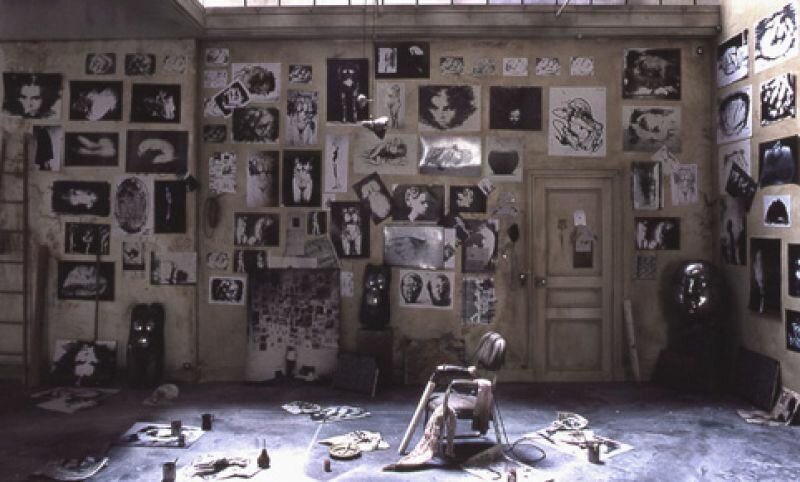
Charles Matton, too, makes replicas of studios and presents them as photographs within a catalogue. His studios are equally miniature and precisely fabricated as Joe Fig’s.
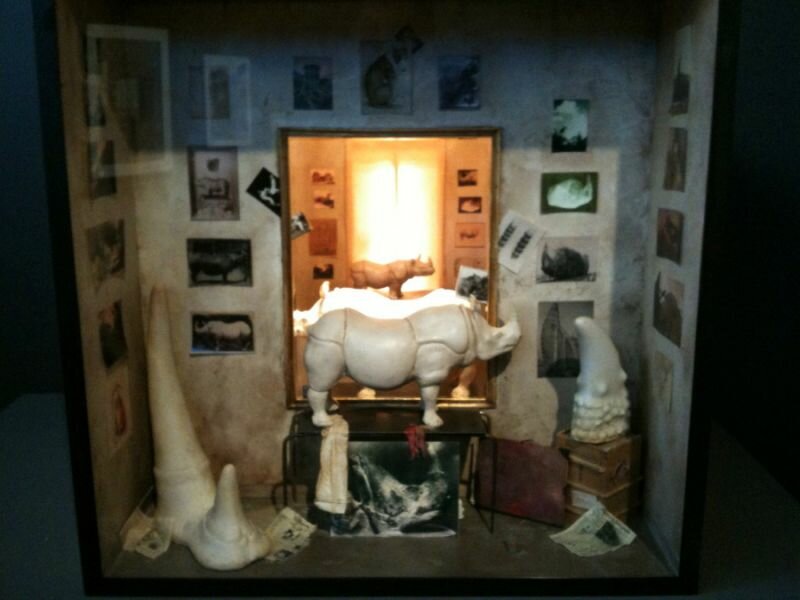
Rhinoceros: Homage to Eugene Ionesco​​

Diorama by Charles Matton, mixed media

Matton wanted to find a modern way to create realistic interiors like the painters of the 17th century, without having to rely on their level of craftsmanship. Initially, he wanted to photograph his friends in their studios and paint over these images. Not too difficult. In the end, he made dioramas in which he carefully made an exact replica of the studio that he photographed. These works were incredibly time consuming and ultimately, the complete opposite of the quick method he initially aspired to. The dioramas were a success (because secretly, everyone loves a doll’s house.)

The dioramas take things a step further because by portraying some sort of primal idea of the sculptor or painter. The spherical sculptures of the modern sculptor fill the space, while in Francis Bacon’s studio chaos prevails. A hippopotamus models in the middle of a studio. These strange boxes, with all their fantasy and precision, explore a world that exists out of our line of perception, even out of our presence.
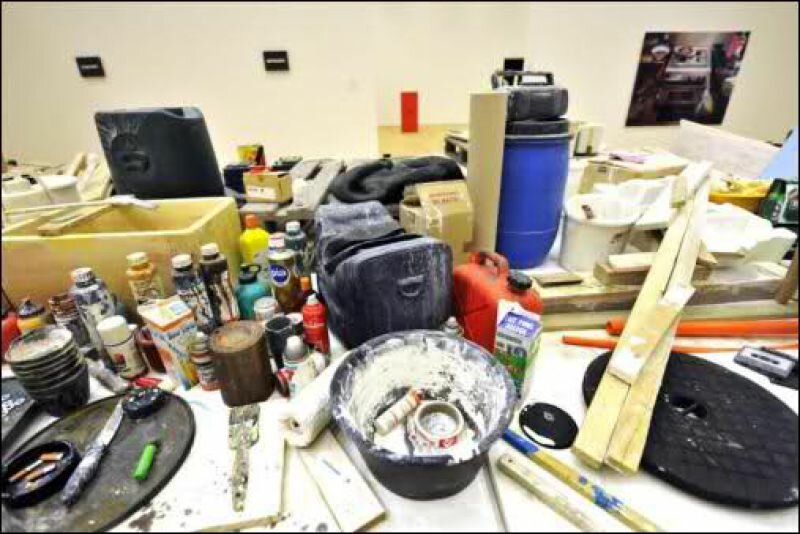
Tisch

Replica of Fischli und Weiss’ own studio by themselves

Fischli and Weiss also made a copy of a studio, their own studio, in full scale. Everything, even the juice packages have been precisely replicated. Just as painfully exact as Joe Fig. But instead of peering through a keyhole into the artist’s sanctuary, you walk through their reality, their reality which is just as banal as our own daily existence. And it’s exactly this deconstruction of the world and it’s enormous ability to place things into perspective that makes this copy genius.

Instead of locking their doors, Fischli and Weiss invite all to enter their holy land. But there’s nothing left to steal here, they’ve already stolen it themselves.
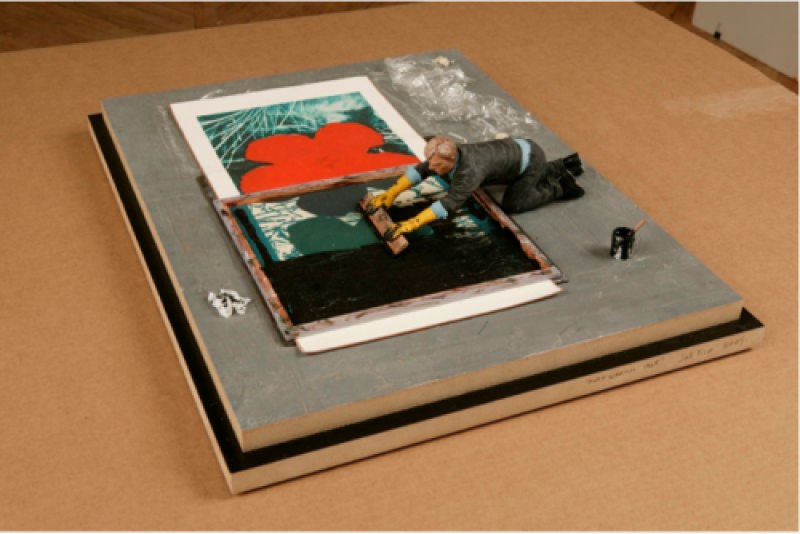
Warhol’s studio

Replica by Joe Fig

Boites Comme Fins en Soi

by Charles Matton

The Neighbours

20.06.2014 BY SARAH VAN SONSBEECK

Since I began working on my project The Neighbours (2006) every sound started to have an impact. At first I couldn’t work properly as I was constantly irritated by the sound of the upstairs neighbours. I was cross with myself that something so trifling could loom so large in my head. I lay on the bed. I tried for a while not to hear anything; it forced itself on the periphery of my consciousness, like a hum, like a dripping tap. I was quite astonished when I realised that this could lead to my making a work. Precisely because it is so trifling. Precisely because it is on the edge of my conscious perception.

The more I became preoccupied with my neighbours, the more sounds I’ve begun to notice. My ears have become more sensitive to detail since listening to my neighbours even for the subtlest of sounds. When visiting someone, I hear more. It is amazing how often you hear someone coughing in the house next door.

This applies even more to hearing the neighbours above me. In the six months they’ve lived here, my home has changed. They have taken over my space. I went mad with irritation lying awake on my bed and so I decided to reverse the roles by taking the noise they made as a starting point for this project . Ironically, I now miss them if I don’t hear them for a minute and I am glad of any strange new sound they start to make. Listening to them gives me a feeling of being busy with something (acute and exciting). I was devastated when they insulated their floor with new underlay flooring. I think it is new but I can’t be sure as I only hear their sounds and I have never met them.

Imperceptibly, the process of being aware of the upstairs neighbours in my daily routines reached the point where one Friday night I realised I was waiting for their shoes to fall next to the bed. I knew how this would sound. I knew that this would be followed by the dreary hum of the satellite dish above my window. I was, I realised, constantly preoccupied with them: people I once briefly spoke to over the phone but with whom I never actually met. I know their bedroom habits down to the most intimate (acoustic) details.

I try to imagine them, but the image remains vague. I imagine them as people who often go to the local gym (on the corner), with something inflated about them, as if they’ve been carefully pumped up to a critical point. But what am I actually basing this on? Also, it isn’t their physical appearance that keeps me awake. It is the space they take up in my home with their sound, since this makes me always aware of them.

Because I hear my neighbours, they’ve actually infiltrated my space: not with their bodies but with their sound. They disturb what my home is for me – a place where I can do what I want and others can’t.

The silence of my home is my home. My private space. But what is this silence in fact? It is not what I would term real silence. There are the birds, my fridge hums, and cars drive past. However, that is the background noise to my home, I am used to it.

There is a prodigious link between sound, space and awareness.

The notion of background sound, already has something spatial about it like a kind of environment, a private room you can always – when it is quiet – take with you. Certain people might feel exactly like this about a lot of sound, which is then their ‘background’ and perhaps they feel uneasy when it is missing. Unexpected noise is saying that this private space doesn’t exist, especially noise from which you can’t escape and about which you can’t do anything. A dripping tap is less frustrating as I know I can also switch it off, but the neighbour’s noise is uncontrollable. The only thing I can do is adjust to it, or phone them up and hear my phone upstairs, or have the music very loud, which gives a kind of temporary satisfaction.

If my upstairs neighbours are unexpectedly quiet, something strange happens. The quietness drives me mad. It is like a story I read about a man who every night was resigned to hearing his upstairs neighbour throwing off his shoes one by one. One night, the upstairs neighbour, in a sudden fit of awareness after having taken off one shoe, thinks the sound is antisocial. He is overcome with guilt. With the precision of a moon landing, he then places the right-hand shoe next to the other. After fifteen minutes he wakes up with a start. He hears a voice crying: ‘For goodness sake, take the other shoe off, then I can get some sleep!’ I am now so used to my neighbours’ routine sounds that they’ve become almost my background noise and indeed I now notice when they’re missing.